
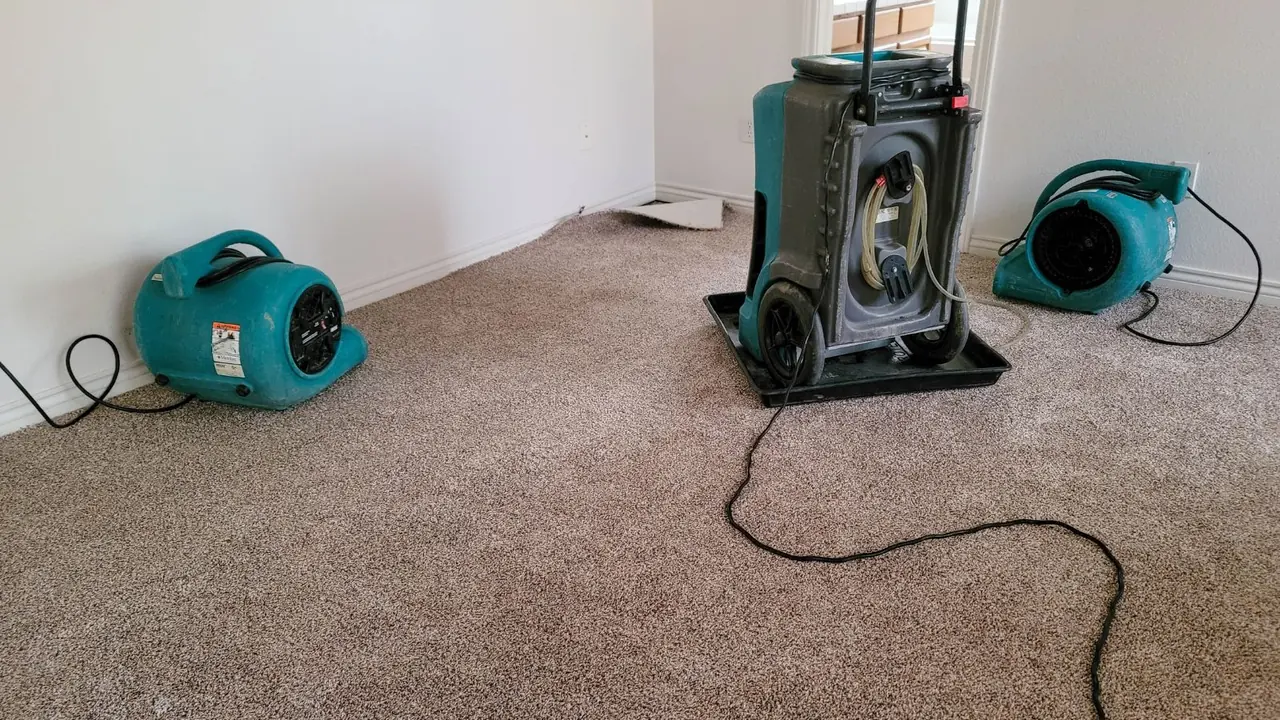
What structural drying is, and why a dry-looking room can still be wet
Structural drying and dehumidification in Calabasas, CA is the phase that starts after water has been extracted and wet debris removed. Its job is to bring framing, subfloor, drywall and concrete back to their normal moisture content. A floor can look and feel dry on top while the plywood under it still holds water.
It differs from the first-day triage on the water mitigation page. Mitigation stops the loss. Drying is the longer stretch that follows, run by readings.
Local weather cuts both ways. Rainfall is modest, since Woodland Hills station data from NOAA, averaged over 1991 to 2020, comes to roughly 16.41 inches yearly, so outdoor air is often dry. Following a winter storm or a failed pipe, a crew still measures first rather than trusting that air to do the work.
Signs the structure is still holding moisture
Some signs show up days after the visible water is gone. Baseboards cup, paint blisters, wood floors crown at the edges, and a room smells stale though nothing looks wet.
A moisture meter and, where needed, a thermal imaging camera show where. The camera finds cooler wet zones behind a finished wall, and the meter confirms the reading on the actual material.
Wet framing or floors?
Call the 24/7 line and describe what got wet. A crew can set the drying plan once they see it.
Call (818) 337-2642Drying safety: the first hour before equipment arrives
Dry equipment pulls a lot of power, and wet buildings are a poor place for guesses. While the 24/7 line dispatches a crew, do these things.
- Cut off the water at its origin. If a pipe is still running, turn the main valve to closed and phone a plumber to repair it.
- If the panel is dry and reachable without standing in water, switch off breakers for wet rooms. If not, leave it and call an electrician.
- Keep household fans, space heaters and extension cords off wet floors.
- Keep people and pets out of any water from a drain, toilet or outside.
- Photograph every wet surface before anything is moved.
How the science works: temperature, humidity and grains per pound
Drying is a vapor problem. Water leaves wet materials as vapor, and the air can only hold so much. The crew tracks three numbers: air temperature, relative humidity, and grains of moisture per pound of air, called GPP. GPP is the useful one because it keeps its meaning when temperature changes.
Warm air takes up more vapor, so a closed, warm room dries faster than a cold one. The room air must stay drier than the wood and drywall so vapor keeps leaving them. For comparison, the EPA says to keep indoor relative humidity below 60 percent, ideally 30 to 50 percent.
Our drying process with real equipment
Classify the loss
ANSI/IICRC S500 sorts water damage into four classes by how much moisture materials hold. Class 1 is a small area of low-absorbing material. Class 2 involves carpet, pad and wet wall bases. Class 3 is water from above that soaked ceilings and insulation. Class 4 is deep saturation in hardwood, plaster or concrete. Before hiring, check that a company really follows S500 on its jobs.
Choose and place the equipment
Air movers sit along walls and across floors to push dry air over wet surfaces. Low grain refrigerant (LGR) dehumidifiers pull water out of the air and suit most house jobs. Desiccant units use a drying wheel and suit cold spaces and very wet Class 3 and 4 losses.
Dry the cavities
Water often sits inside walls and under cabinets. The crew may drill small holes at the wall base or pull a baseboard and move warm, dry air into the cavity. Under floors, drying mats pull moisture from the layer between finish and subfloor.
Log it every day
A technician returns daily to record temperature, humidity, GPP and moisture readings at the same marked spots, then removes equipment from areas that reach their dry standard. The log also helps document the loss for your insurer.
When drying stalls and what a crew does about it
Sometimes readings stop falling. Common reasons are a hidden leak, a wall cavity never opened, insulation holding water, or a sealed layer on a floor. The crew checks the source first, then opens more of the structure or adds a different dehumidifier.
Materials that cannot reach a dry standard get removed. The California Department of Public Health warns that building materials with pores, if left damp for a day or two, may have to come out.
How long does drying take, and why open windows are not a plan
There is no honest fixed number of days. Duration depends on the water category, class of loss, materials and starting moisture. Thin drywall can finish quickly. Hardwood, plaster and concrete are slower.
Open windows are no substitute for equipment. On a humid day they bring in more vapor, in rain they add water, and they defeat a dehumidifier.
What changes the cost of structural drying
No honest number can be given before someone sees the loss. These are the things that move the price.
- Square footage and rooms affected, including floors above and below.
- Class of loss and materials, since dense materials dry slowly.
- Water category, because Category 2 or 3 water can mean removal before drying.
- Days on site and amount of equipment.
- Cavity access: opening walls, lifting floors or pulling cabinet bases.
Settle the scope and the cost on paper ahead of day one. A drying contract worth $1,000 or above, counting both labor and materials, must be held by a licensed contractor under the Contractors State License Board. Its deposit limit is the lesser of $1,000 and 10 percent of the contract.
Insurance fit for drying costs
Document the drying, then ask your insurer
A burst supply line is sudden and accidental, so policies commonly pay for it. Slow leaks and poor upkeep commonly fall outside coverage. Water that enters from outside the house, as in a flood, typically requires its own flood policy. Read your policy and confirm the specifics with your insurer.
The California Department of Insurance explains that later damage can go uncovered when an owner fails to take sensible steps, and that sensible protective spending is repaid if you keep the receipts. Moisture logs and photos are the kind of record that supports a claim. A restoration crew does not decide your claim.
Mistakes to avoid during drying
- Turning equipment off at night. Drying stops when it stops.
- Closing walls or laying flooring before readings reach the dry standard.
- Running a household fan and calling it done.
Rebuilding comes after drying passes. For affected floors, see carpet water damage restoration.
Drying homes across the Calabasas area
Calabasas publishes a Housing Element background report, and it puts 73 percent of local homes as predating 1989. In older houses, wall cavities and floor assemblies hold more layers, so ask the crew which cavities they plan to open and why.
We also work in Westlake Village and Woodland Hills, and the method is the same.
Frequently asked questions
Is emergency structural drying available in Calabasas?
Yes. The 24/7 line takes calls at any hour, and the network sends licensed and insured crews the same day when one is available. No arrival time is promised. Setting up dehumidifiers and air movers early matters because the EPA advises drying wet areas within 24 to 48 hours.
What is the difference between an LGR and a desiccant dehumidifier?
An LGR unit chills air to condense water and works well in warm rooms on typical residential jobs. A desiccant unit uses a drying wheel, which keeps working in cooler spaces and on very wet or dense materials. The crew picks one after reading the room.
Can I just run fans and open windows?
Usually not. Household fans move air but do not remove vapor, and open windows let humid or rainy air in. Wet drywall, wood and concrete need dehumidified, controlled air so moisture keeps leaving them.
How do I know when the drying is finished?
Finished means the material readings match a dry standard set from unaffected parts of your home. The crew compares wet and dry spots, then removes equipment. Ask for the final readings before anyone closes walls.
Does drying prevent mold?
Fast, complete drying lowers the chance of mold because mold needs moisture. It cannot promise mold will never appear. If you already see or smell mold, that is a separate job covered on the mold remediation page, and health questions go to a physician.