
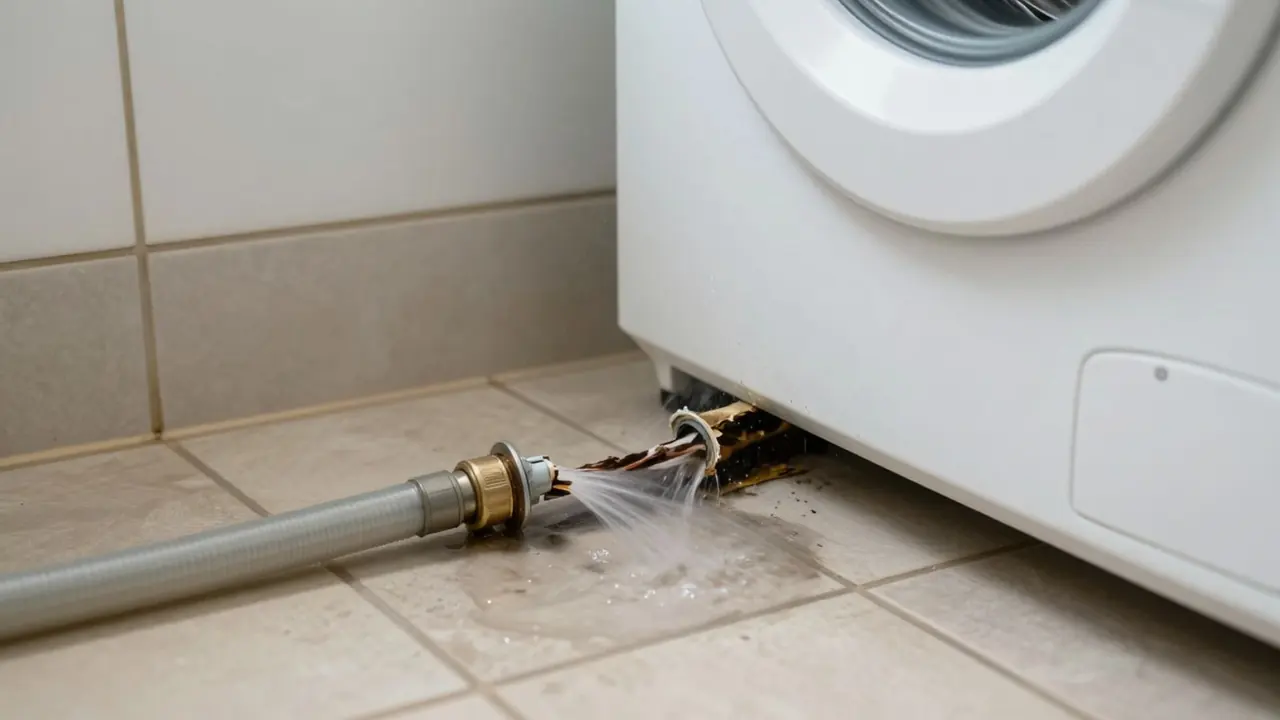
How appliance leaks soak a home
Appliance leak water damage in Calabasas, CA usually starts with one small part: a washing machine fill hose, a dishwasher drain, a refrigerator ice-maker line or a laundry drain pan that overflows. Calabasas planning documents tallied 9,230 homes across the city in 2020, and roughly 73 percent of that stock is detached houses, so most of these leaks happen in a laundry room or kitchen of a stand-alone house.
That matters because most of those homes have a laundry room, a kitchen and often a utility closet with at least one appliance tied to a supply line. Each connection is a place a rubber hose can age out.
A hose failure and a slow weep are different problems. A burst hose can put out a lot of water in an hour and flood a room. A weeping fitting may drip a cup a day for weeks, and nobody notices until a cabinet floor goes soft.
What you see, and what it usually means
| What you notice | What it often means |
|---|---|
| Damp floor in front of the washer | A hose, valve or drain connection has failed or the pan overflowed |
| Soft or swollen cabinet toe-kick near the dishwasher | Water has been wicking under the unit for some time |
| Cupped or lifting flooring beside the refrigerator | An ice-maker or water-dispenser line is seeping into the subfloor |
| Musty smell in a laundry closet | Moisture is trapped behind or under the appliance |
| Stain on a ceiling under an upstairs laundry room | Water has moved through the floor assembly below the machine |
Water follows the lowest path, then soaks sideways into baseboard, flooring seams and the underside of cabinets. A surface that feels dry can still hold water a few inches below.
Wet floor near an appliance?
Tell the dispatcher what leaked and where. Call the 24/7 line and get the next steps while the water is still fresh.
Call (818) 337-2642First-hour safety steps
- Close the shut-off valve behind or beside the appliance, or turn off the home's main water valve if the valve is stuck or the hose is spraying.
- Unplug the appliance only if the outlet and the floor around it are dry and you are not standing in water. If you are unsure, turn off the breaker for that area instead.
- Keep children and pets out of the wet room, since water on tile or vinyl is slippery.
- Take photos and short video of the appliance, the hose and the wet areas before you move anything.
- Lift rugs, boxes and cardboard off the floor, then call the 24/7 line.
If the water is rising, coming from a drain or smells like sewage, stay out of it. A plumber or appliance technician fixes the appliance. The restoration crew handles the water.
How the crew works the job
The crew starts by finding how far the water went, not just where it showed. They use a moisture meter on flooring, drywall and cabinet bases, and often a thermal camera to spot cool, wet areas behind a wall or under a cabinet. Wet readings get marked so the drying plan has a baseline.
Pull the appliance for inspection
Washers and dishwashers are moved out so the crew can see the floor, the wall behind and the valve. The appliance owner or a technician should confirm the leak source is fixed.
Extract the water
A wand or small extractor pulls standing water from flooring edges and carpet pad.
Open what is trapped
Toe-kicks, a strip of baseboard or a small section of wet drywall may be removed so air can reach the wet cavity.
Dry the structure
Air movers push air across the wet surfaces while a low-grain refrigerant (LGR) dehumidifier pulls moisture from the air. Mats or injection ports can dry material that cannot be opened up.
Check and record
Readings are taken daily until they match dry reference material. A fair question for any bidder is whether the crew follows the S500 water damage standard from ANSI and IICRC.
Speed in the first day or two limits the cost. The early steps are covered on the water mitigation page.
What changes the cost of an appliance leak job
- How long the water ran. A one-hour hose burst is usually simpler than a weep that went on for weeks.
- The flooring. Vinyl plank, tile, laminate and engineered wood all dry or fail differently.
- Cabinets. If water got into the base cabinets or behind them, drying and removal take more time.
- How many rooms the water reached, including a room below or beside the laundry area.
- Whether drywall, insulation or carpet pad must be removed and whether any of the wet material is a sanitation concern.
We do not quote numbers on a web page because the scope changes the price. Call the 24/7 line and tell us what the washer, dishwasher or fridge did. A dispatcher then walks through the work and its cost before anyone starts.
Insurance and appliance leaks
Sudden leak or slow leak
Sudden and accidental water damage is often covered under a homeowners policy. Damage from a leak that went on for a long time, or from worn parts that were never maintained, is often excluded. Policies differ, so check your policy or ask your insurer.
The California Department of Insurance says a carrier has 15 calendar days to confirm it received your claim, then 40 days after proof of loss arrives to say yes or no. Keep photos, receipts and the failed hose or part if you can. A restoration crew documents the damage but does not decide your claim.
Mistakes to avoid after an appliance leak
- Pushing the appliance back into place before the floor under it is dry.
- Mopping and calling it done, while the toe-kick and subfloor stay wet.
- Running a fan in the room and skipping a moisture check.
- Throwing out the failed hose before you take a photo of it.
- Hiring for a job over $1,000 without checking the license.
On that last point, the Contractors State License Board says any job where labor plus materials reach $1,000 needs a licensed contractor, and it recommends keeping any deposit to a tenth of the contract or one thousand dollars, using the lower of the two. Our network dispatches licensed and insured contractors.
Where appliance leaks overlap with other pages
If the water came from a sink, cabinet or kitchen appliance and the kitchen is the main damaged space, the kitchen water damage restoration page covers cabinets, counters and flooring in that room. Neighbors in Woodland Hills and Westlake Village call us for the same kinds of leaks, and we serve Calabasas and nearby towns.
Frequently asked questions
Is emergency appliance leak water damage service available in Calabasas?
Yes. Call the 24/7 line and a local dispatcher will explain what happens next. Same-day response is offered when available. While you wait, shut off the valve for the appliance, take photos and move belongings off the wet floor.
Who fixes the washing machine hose, the plumber or the restoration crew?
The hose and the appliance are fixed by a plumber or an appliance technician. The restoration crew removes water, dries the room and repairs what the water damaged. It helps to have both lined up so the leak is stopped before drying starts.
The floor looks dry now. Do I still need drying?
Maybe. Water can sit under vinyl, behind a toe-kick or inside a subfloor with no visible sign. A moisture meter reading shows whether it is truly dry. If the leak was more than a day or two old, get readings before you rebuild or cover anything.
Can the appliance stay in place while you dry the floor?
Usually not. The crew needs to see and reach the floor and wall behind it. A dishwasher or washer is pulled out, checked and put back after the area is dry and the leak source is fixed.
How long does drying take after a washer or dishwasher leak?
It depends on the flooring, the amount of water and how long it sat. Many jobs take several days of equipment running, with daily readings. Thick materials and wet cabinet cavities take longer, so a firm day count is not something to promise up front.
Will my insurance pay for an appliance leak?
It may, when the leak was sudden and accidental. Slow leaks and neglect are often excluded. The appliance itself may not be covered at all. Read your policy and ask your insurer, since we cannot say what a specific policy will pay.