
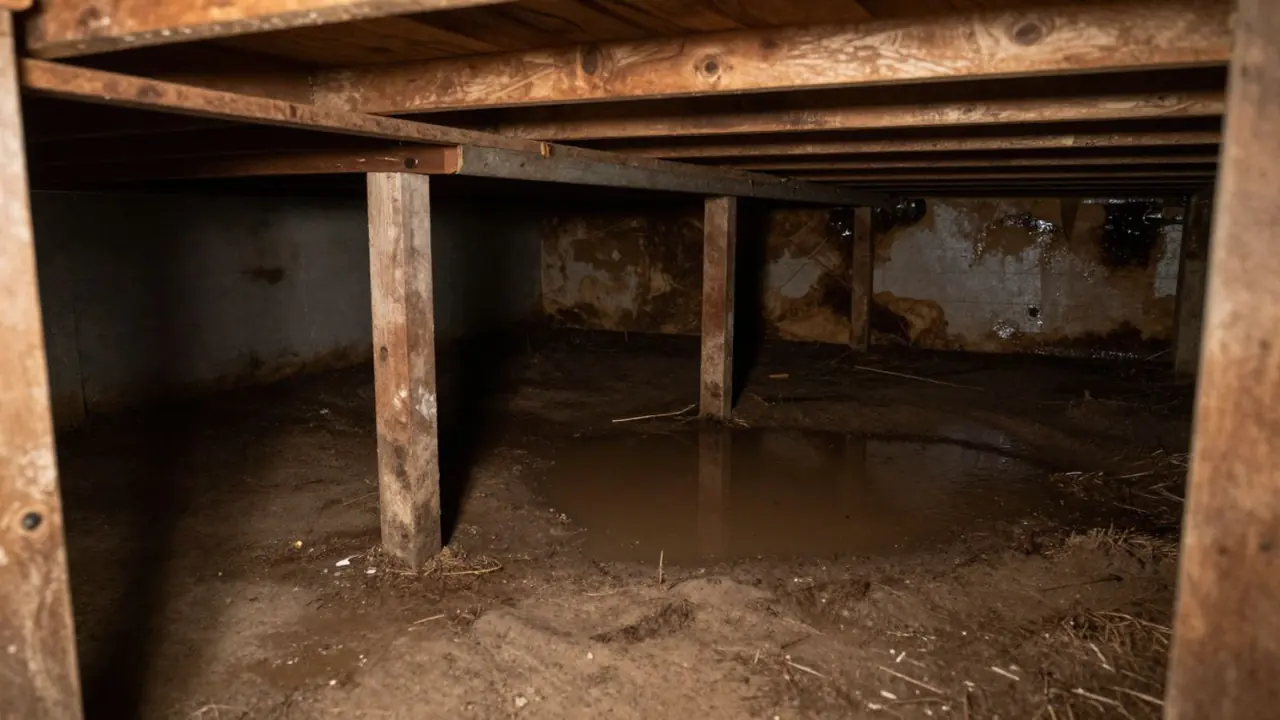
Water under the floor right now: first-hour safety steps
If you can hear dripping below the floor, see water at the crawl space vent or access hatch, or the floor feels soft, treat it as urgent. Crawl space water damage in Calabasas, CA gets worse quietly because wood, insulation and subfloor soak it up. Dispatch answers at every hour, and a licensed, insured team heads out once a crew frees up. Until then, work through the list below.
- If a pipe may be feeding the water, shut the home's main valve first.
- Do not climb into a flooded crawl space. Wet wiring, tight space and bad air make it a poor place for a homeowner.
- When the breaker panel is dry and easy to reach, turn off any circuit that serves the area under the house.
- Keep children and pets away from the hatch and any water that came from a drain.
- Photograph the water line, the hatch and any wet floors above.
A restoration crew removes water and dries wood.
Does this page apply to your home?
This page is only for homes with a raised foundation, where the floor sits above an open space you reach through a hatch or a small door. We found no published count of crawl spaces in Calabasas, so we will not tell you how many homes have them. A vent screen at the base of an exterior wall or a hatch in a closet floor are the usual clues.
If your house sits directly on concrete, the leak page to read is burst pipe water damage, and a leak under a slab belongs with a plumber first. If you have a basement or lower level with finished rooms, ask about flood damage restoration instead.
Water under your floor?
Call any time, describe the hatch and the water level, and a crew will be arranged.
Call (818) 337-2642Symptoms that point to a wet crawl space
Most people only see what the crawl space does to the rooms above.
- Floors that bounce, cup, buckle or feel spongy near exterior walls.
- A musty smell that is strongest near floor vents or in closets over the crawl space.
- Standing water or a dripping pipe visible through the hatch with a flashlight.
None of these proves a flood on its own. A moisture meter reading on the floor above and a look underneath tell the crew which cause it is.
Where the water comes from in this area
Calabasas maps only a sliver of its land as high flood risk. The city's Safety Element, built on FEMA data, puts that sliver along Las Virgenes Creek in the west, inside the 100-year floodplain, and says most of the rest of the city is outside any designated flood zone. An unmapped address can still collect water beneath its floor.
That document also cautions that a hard downpour can swamp the storm drains, and that the FEMA boundaries ignore future climate shifts. Rain here comes in a season. The NOAA station at nearby Woodland Hills averages roughly 16.41 inches per year over its 1991 to 2020 normals, mostly in winter. Once a storm passes, walk the low spots and downspouts around the foundation.
Rain is not the only culprit. A split supply line or a failed drain fitting can fill the space during the dry months.
Safety and access limits under the house
Crawl spaces are tight, so crews work on their knees or bellies, wear respirators, gloves and coveralls, and bring work lights. Electrical hazards are real because outlets, junction boxes and low wiring may be wet.
Some spaces cannot be entered safely. Cramped access, active sewage or deep mud can limit the work, and the crew will tell you what could not be reached.
If water looks gray or smells like a drain, treat it as contaminated and stay out. The water category changes what has to be removed.
How a drying job unfolds beneath the floor
Find the source
The crew looks for the leak, the drain failure or the rain path. A plumber must stop any leaking pipe first.
Pump out the water
Submersible pumps and a wet vacuum with a long hose move standing water out of the space. Shallow water on soil is extracted by hand wand where a pump cannot reach.
Pull what cannot stay
Soaked, sagging insulation and wet vapor barrier sheeting are usually removed and bagged.
Measure the wood
A pin moisture meter is pressed into joists, sill plates and the underside of the subfloor. Thermal imaging helps find wet sections in the floor above.
Dry the space
Air movers circulate air across wood, and LGR dehumidifiers pull water out of the air. The multi-day method is explained on the structural drying and dehumidification page.
Treat and recheck
Surfaces may get an antimicrobial treatment, and a final set of readings shows the wood is back in range. Any company you hire should be able to name the written industry standard behind its drying plan, such as ANSI/IICRC S500.
Wet soil keeps releasing moisture, so readings are rechecked before equipment leaves.
What changes the cost of crawl space water work
Nobody can give an honest number unseen. These factors move the price most.
- How deep the water is and how much has to be pumped.
- Water category, since contaminated water means more removal and protection.
- How many joists and floor areas read wet, and how long drying equipment must run.
Get the scope and price on paper ahead of any work, and question anything added later. State law sends contractors through the Contractors State License Board for work worth $1,000 or more counting labor plus materials. That board also suggests a deposit capped at 10 percent or $1,000, whichever amount is smaller.
Insurance and crawl space water
How coverage usually treats it
Coverage turns on where the water came from. An abrupt, accidental event such as a ruptured supply line is often covered, while slow seepage, neglect and surface flooding frequently are not. Homeowners policies typically exclude rising flood water, which is insured separately, often via the federal NFIP. Read your policy, then ask your insurer which bucket your loss fits.
The state insurance department urges homeowners to hold losses down with interim fixes, because later damage may go unpaid when sensible steps were skipped. Save every receipt. The restoration crew records the water and the meter readings, yet your insurer alone rules on the claim.
Common mistakes to avoid, plus prevention before the next storm
Waiting to look is the classic error. The EPA's window for stopping mold is a day or two, roughly 24 to 48 hours after a wetting, and a crawl space seldom gets checked in that time.
- Do not replace insulation before the wood has dried.
- Do keep gutters and downspouts directing water away from the foundation.
- Do ask a plumber to inspect exposed lines if you hear drips.
Prevention lowers the odds but cannot rule out a repeat. Heavy rain or a broken pipe can still send water under the house.
Serving homes around Calabasas
The phone line answers callers from Calabasas and the surrounding area, including canyon homes on the Topanga water damage page and homes on the Agoura Hills page. Say how deep the water looks and whether the pipe is shut off.
Frequently asked questions
Is emergency crawl space water damage service available in Calabasas?
Yes. Phone the round-the-clock line and tell the dispatcher what you see. A licensed, insured crew is routed to you once one is free, and you will get advice on protecting the house in the meantime.
How do I know if I have a crawl space and not a slab?
Look for a hatch in a closet or hallway floor, or a small vent screen near the bottom of an exterior wall.
Will the floor above need replacing?
Not always. Framing and subfloor that dry to normal meter readings can stay. Cupped boards, sagging subfloor and soaked pad may not. The crew decides from readings, not looks.
Is crawl space water damage covered by homeowners insurance?
The cause decides it. An abrupt pipe break is frequently covered, but rising surface water usually calls for a separate flood policy. Check the policy and talk to your insurer first. Crews record the damage and leave coverage rulings to the carrier.
How long does a crawl space take to dry?
It depends on the depth of the water, how wet the soil is and how much framing absorbed it. Some jobs wrap up in a few days. Others take longer if the ground keeps releasing moisture. Daily readings, not a calendar, show when the wood is dry.