
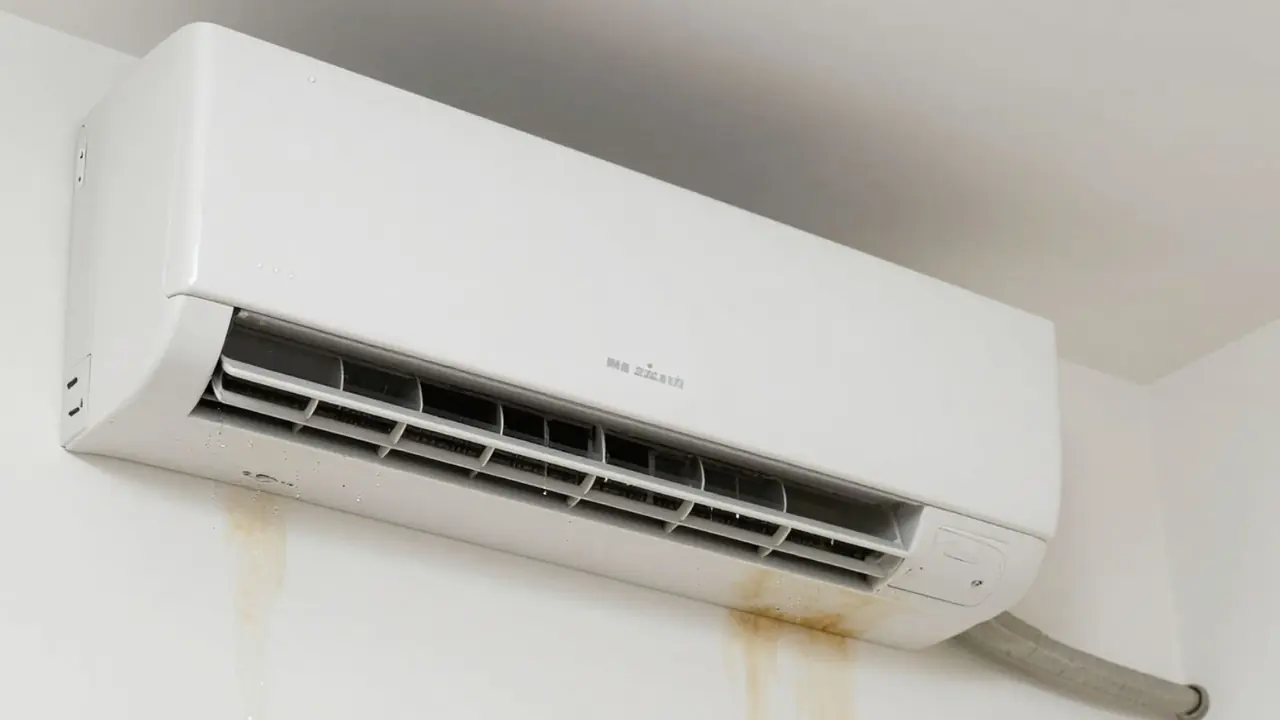
Why air conditioners leak water inside Calabasas homes
Repairing AC leak water damage in Calabasas, CA begins with how cooling works: the system wrings moisture from indoor air, and that water needs an exit. It runs into a drain pan, then through a condensate line to a drain or the outdoors. When any part of that path fails, the water ends up in your ceiling, wall or closet.
The usual culprits are a clogged condensate line, a rusted or cracked drain pan, and an evaporator coil that iced over and then thawed all at once. Ductless mini-split units add another one, a wall unit that drips from a tilted body or a blocked drain hose.
Calabasas planners describe much of the established housing stock as dating from the 1960s through the 1980s, per the city's January 2021 Housing Element background document. In houses of that vintage, a replaced air handler is often tucked in an attic or hall closet, with a pan under it that may be original or missing. Ask your HVAC company what protects the space under yours.
A cooling season that runs longer than the rainy one
Climate averages from NOAA for 1991-2020, recorded at neighboring Woodland Hills, put the typical daily high at 88.5 degrees in June, 95.1 in July, 97.4 in August, 93.9 in September and 85.2 in October. That is five months of heavy air conditioner use, and each hour of cooling makes condensate.
Rain is a different story. The same normals put June through September under 0.1 inch a month, and about 16.41 inches a year, mostly December through March. So a new ceiling stain in August is far more likely to come from the air conditioner or a plumbing line than from the roof. That is an inference from the numbers, not a count of local leaks, and a roofer or plumber can confirm the source.
Ceiling stain under the air handler?
Describe what you see and the dispatcher will help sort what needs drying now. Call the 24/7 line.
Call (818) 337-2642Stains, drips and musty closets: what you are seeing
The first sign is often a tan or yellow ring on a ceiling below the attic or closet that holds the air handler. Others are bubbling paint, a soft patch of drywall, water in the drain pan when you open the closet, or a wall unit that drips onto the floor.
A leak that only shows while the system runs points at condensate. A stain that appears only after rain points elsewhere. Rust on the pan, water stains on the closet floor, and a damp smell near the unit all mean the leak has been going for a while.
First-hour safety steps when the AC is leaking
Turn the thermostat to off first. That stops new condensate and removes the load from the unit. Then find the breaker or the service switch for the air handler and switch it off, but only if you can reach it dry.
Do not touch a light fixture, outlet or ceiling fan below a wet ceiling. Water inside a fixture is an electrical risk, so leave the circuit off and keep people out. A sagging ceiling can drop wet drywall and insulation without warning, so stand clear and do not poke it.
- Switch the system off at the thermostat, then at the breaker if the panel is dry.
- Set a bucket beneath any active drip, then clear rugs and furniture away from the wet zone.
- Photograph the stain, the unit and the pan before anything is changed.
- Call an HVAC technician to fix the cause and the 24/7 line to start drying.
How the crew dries and rebuilds after an AC leak
The crew starts with a moisture meter and, in many homes, a thermal imaging camera to trace how far the water traveled along joists and across the ceiling.
Wet insulation is bagged out. Saturated drywall is cut back past the damp edge, and the cavity above gets air movers and a low-grain refrigerant dehumidifier. For a wall behind a mini-split, small holes or a lifted baseboard let dry air into the cavity. The goal is to bring materials to the dry standard in ANSI/IICRC S500, and it is fair to ask a contractor if the crew follows that standard.
Rebuilding follows only after readings come down. That means new insulation, drywall patching, taping, texture to match, primer and paint. The drying phase is covered in more detail on the structural drying and dehumidification page, and the finish work for stained or collapsed ceilings is explained on the ceiling water damage repair page.
Who fixes what: HVAC tech, plumber and restoration crew
A restoration crew does not repair air conditioners. An HVAC technician clears the condensate line, replaces the pan, or fixes the coil and float switch that should have shut the system off. If the leak is from a plumbing line near the unit, that is a plumber.
What changes the cost of AC leak repair
Quoting a figure sight unseen would be guesswork. A phone call lets a dispatcher ask useful questions, and the dispatcher walks you through what is included and what it costs before crews begin. Several factors push a job larger or smaller. Crews serve Agoura Hills and West Hills as well.
- How long the leak ran, since weeks of drips soak more insulation and framing.
- Whether the water reached a ceiling only, or also a wall, carpet or cabinets.
- Wet insulation volume and the size of the drywall cut-out.
- Access to an attic or closet, which affects labor.
- Texture and paint matching across a whole ceiling plane.
Insurance and AC leaks
Sudden versus gradual
Many homeowners policies treat sudden and accidental water damage differently from slow, repeated seepage. A drain line that burst or overflowed one afternoon may be viewed differently from a drip that ran for months. Flood is a separate matter, and AC condensate is not flood.
Check your policy, ask your insurer, and keep receipts and photos. The restoration crew documents moisture readings but does not decide your claim.
Mistakes to avoid and ways to prevent the next leak
The most common mistake is patching the stain and painting over it. Paint hides the problem and traps moisture above it. A second is running the AC all day to dry the room, which makes more condensate. A third is pouring bleach into the drain line, since it can damage the pan and fittings.
- Have the condensate line flushed before the hot months start.
- Install a float switch if the unit does not have one.
- Check the drain pan whenever you change the filter.
- Replace a rusted or cracked pan early.
Frequently asked questions
Is emergency AC leak water damage repair available in Calabasas?
Urgent protection and drying are available around the clock through the 24/7 line. Rebuilding the ceiling or wall is scheduled after drying, once the leak source is fixed. Call and describe what you see so the dispatcher can sort what is urgent from what can wait.
Can a clogged AC drain line really ruin a ceiling?
Yes. A blocked line sends condensate into the pan, the pan fills, and the overflow drips onto whatever sits below. In an attic or closet unit that is often the ceiling drywall and insulation. Weeks of slow drips can stain and soften it before you see anything.
Should I turn the air conditioner off if it is leaking?
Yes, at the thermostat first. Running a leaking unit adds water and can freeze the coil further. Switch off power at the breaker only if the panel is dry. Then call an HVAC technician for the repair.
How do I know if the leak is from the AC and not the roof?
Timing helps. A stain that grows when the system runs, in dry months, points at the AC. A stain after rain points at the roof or flashing. A plumber or roofer can confirm. Local rainfall is low from June through September, so summer stains often trace back to cooling or plumbing.
Will the ceiling stain go away once the AC is fixed?
No. The repair stops new water, but the stain stays and the drywall may still be wet. The crew checks readings first, then replaces damaged sections and applies stain-blocking primer once the area is dry.