
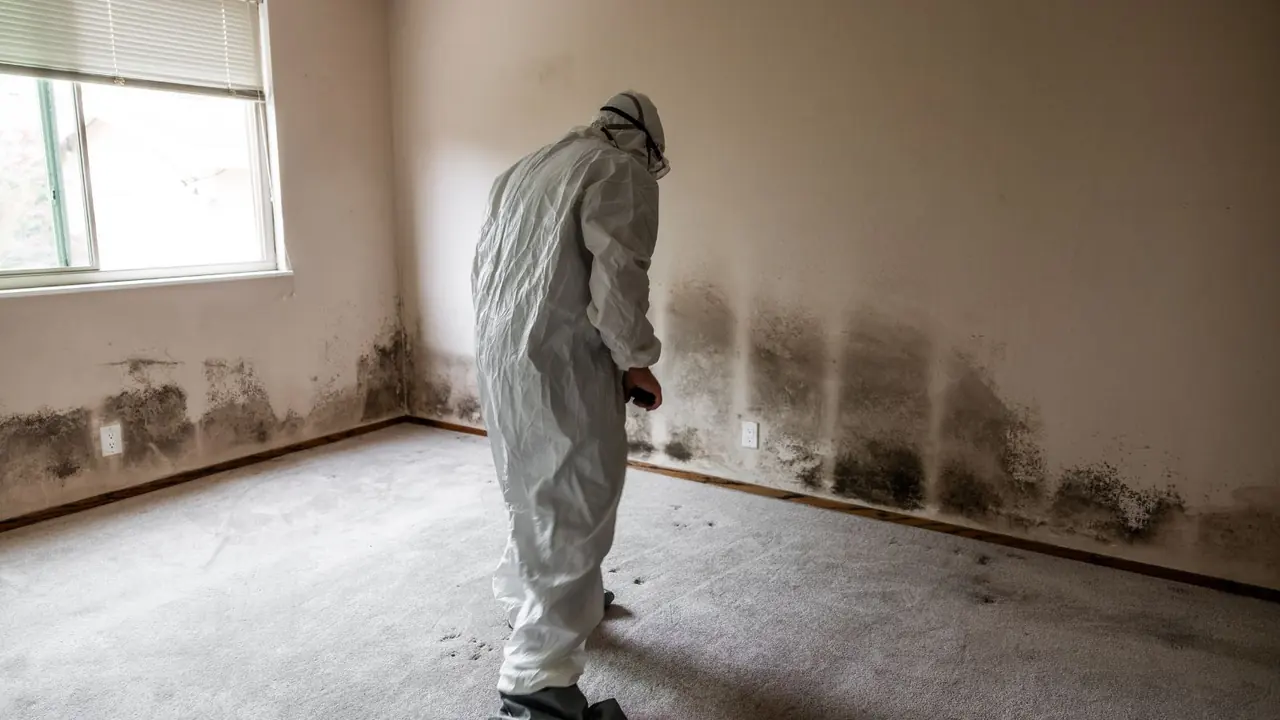
Think of the room as a climate, not a wall
A lower-level room sits against soil, often with less sunlight and less airflow than the rest of the house. Cool surfaces, still air and stored boxes make a good place for moisture to settle. If your Calabasas home has a basement or lower level, that room is the one to measure before you scrub anything.
This guide is about the room's air and its water sources. If you are weighing how to handle a specific wall surface such as drywall, block or framing, that is a separate question with its own answers. Here the aim is to find out why the room stays damp and to bring it back to normal.
Start with a small digital hygrometer. They are cheap, and a reading in the morning and evening for a week tells you more than the smell does.
Humidity targets and the dehumidifier question
Many building guides suggest keeping indoor humidity roughly between 30 and 50 percent. A lower room that sits above 60 percent for days at a stretch is giving mold what it needs. A dehumidifier is the usual first tool, but it only treats the air. It does not repair a leak or remove existing growth.
Sizing comes down to three questions. How large is the space, how wet is it, and where does the water go? A unit's rating is stated in pints removed per day under test conditions, and those conditions are kinder than a damp lower room. Go up a size from what the square footage alone suggests if the room feels clammy or has had water in it.
Look at drainage too. A bucket that fills every few hours will not get emptied while you are at work. Choose a unit with a pump or a hose that runs to a floor drain or sink. Keep it running with the door open, set it around 45 to 50 percent, and clean the filter.
Professionals use LGR dehumidifiers and air movers, which pull far more moisture out of the air and the materials. If you are still deciding how to stop moisture before it builds, water mitigation covers the first days after a leak.
Humidity won't come down?
Call the 24/7 line. We can take moisture readings and tell you whether this is a DIY job.
Call (818) 337-2642Find the moisture source before you treat anything
Mold grows where a damp surface stays damp. Removing it without fixing the water brings it back. A lower room usually gets its moisture from one of five places.
Seepage is water pressing through foundation walls or slab after rain. Plumbing leaks include supply lines, drain lines, a water heater, a washing machine hose or a refrigerator line. Condensation forms when warm humid air hits a cold surface, such as a cold-water pipe or concrete.
Surface drainage means roof runoff or yard grading pushes water toward the foundation. Humid air gets in from a dryer vent that is not vented outside, or a bathroom fan that stops short of the exterior.
A simple slab test separates two of these. Tape a square of clear plastic to the floor or wall, seal all four edges, and leave it for 24 to 48 hours. Moisture on the underside of the plastic points to seepage through the slab. Moisture on the outside surface points to humid room air condensing.
Contents, storage and the air handling
Cardboard, books, upholstered furniture and rolled carpet all hold moisture and feed growth. Move them out of the room and onto shelves or into plastic bins. Lift anything off the floor by a few inches.
Check supply registers and return grilles as well. If there is mold on a vent or you notice a musty odor when the HVAC starts, stop using the system in that zone and have a technician look. Mold spores can travel with air, and a contaminated duct needs more than a wipe-down.
Bleach-based products do not penetrate soft materials, and mixing cleaners can release dangerous fumes. Use detergent and water for hard, nonporous surfaces and discard anything porous that is moldy.
DIY or professional: a decision table
| Situation | Reasonable to handle yourself | Call a professional |
|---|---|---|
| Small isolated patch on a hard surface | Yes, once the source is fixed | If it returns within weeks |
| Mold on drywall, carpet or insulation | Remove small pieces of discarded material carefully | If the area is large or spreading |
| Water came from a sewage backup | No | Always, because it is Category 3 water |
| Standing water or soaked flooring | No, extraction is needed | Same day |
| Musty smell with no visible source | Watch humidity, check hidden spots | If readings stay high or the smell persists |
| Mold near HVAC or ducts | No | Yes, with an HVAC technician |
| Anyone in the home is worried about symptoms | See a physician | Yes, to check conditions |
When a job outgrows a cleanup, mold remediation means containment, HEPA air filtration, removal of affected material and drying to S520 practice. The California Department of Insurance notes that because mold can be dangerous to health, testing and cleanup should be done as soon as mold is detected.
What a crew does and does not do
Crews measure moisture, set containment, filter the air, remove what cannot be saved, and dry the room with equipment. They do not diagnose health problems, and they do not decide your insurance claim.
The state health department says California neither licenses mold assessors nor writes rules for mold inspection or cleanup. That makes it worth asking any company whether its crews work to ANSI/IICRC S520 and how the work gets checked at the end.
Where Calabasas flood zones do and do not apply
Most of the city sits outside a designated flood zone, the city's Safety Element says, with a small western portion inside the 100-year floodplain. FEMA's mapped zone follows Las Virgenes Creek on that side. The element also cautions that heavy rain can outrun storm drains, and that the FEMA maps leave out future climate effects.
The practical point is that a damp lower room may have nothing to do with a flood zone at all. Most wet-room mold starts with a plumbing leak, condensation or poor drainage. If the room is on the western side near the creek, or if water has come in after heavy rain, you also need to ask whether the water was floodwater, because insurance treats it differently.
Frequently asked questions
Do I need flood insurance for a damp lower-level room in Calabasas?
CDI says flood, mudslide and debris flow are typically left out of standard homeowners coverage, and the National Flood Insurance Program is where flood protection is usually bought separately.
That matters most for the western part of the city near Las Virgenes Creek. Ask your insurer what your policy covers before you assume anything.
What size dehumidifier does a lower-level room need?
It depends on the floor area, the starting humidity, and whether the room has had water. A damp room needs a larger rating than a dry one of the same size.
Use a hygrometer. If the reading will not drop below the 50 percent range after several days of running, the unit is too small or the moisture source is still active.
Does running a dehumidifier kill mold?
No. It removes moisture from the air, which stops new growth. Existing growth stays on the surface until it is cleaned or the material is removed.
Think of it as maintenance after the cause is fixed.
How do I know whether the moisture is seepage or condensation?
Tape plastic to the surface for 24 to 48 hours. Moisture under the plastic suggests water is coming through. Moisture on top suggests the room air is condensing on a cold surface.
If the results are mixed, a restoration crew can use a moisture meter and thermal camera to map it.
Should I have the air tested for mold?
Testing can help find a source, but it has limits. The California Department of Public Health says there are no state exposure limits for indoor mold, so a number from a test has no legal pass or fail line.
Moisture readings and a visual check usually tell you more. The same approach applies in Woodland Hills and Topanga, and a crew can explain what a test would add.