
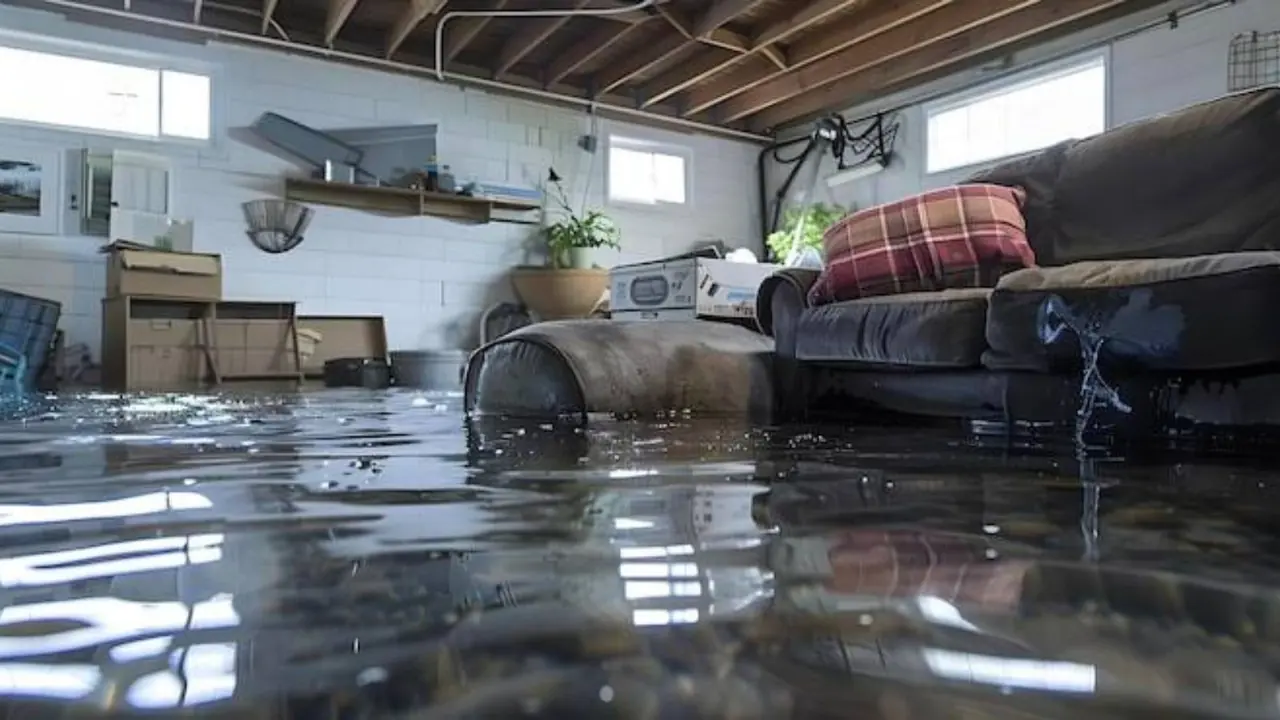
What to do while water is still in the lower level
Water in a below-grade room has nowhere to go by gravity. It waits for a sump pump, a floor drain or a crew with a pump. That is why a few inches of water can stay for days and keep soaking drywall, carpet pad and stored boxes.
Your first job is to learn where it is coming from. A split supply line, a failed water heater, a backed up drain and groundwater pushing through a wall all need different repairs, and the water type changes what can be saved.
Stop the source if you can
Shut the main water valve when a pipe or water heater is the cause. If the water is rising from a floor drain or toilet, stop using every fixture in the house.
Treat the room as live electrically
Do not wade into standing water while outlets, a furnace or a freezer on that level may still be powered. If the panel is dry and reachable, switch off the circuits for the wet area only.
Keep people and pets out
Water that came from a drain, a washing machine or the ground can carry contamination. Children and pets should stay upstairs until the water is gone.
Lift what you can reach
Move electronics, documents and photo boxes to higher ground. Leave heavy furniture and anything that means wading into deep water.
Photograph before moving things
Take wide shots and close ups of the waterline, damaged items and the source. These help later with the claim and with the scope of work.
Work out which kind of water you have
Restoration crews sort water into three categories under the ANSI/IICRC S500 standard. Category 1 comes from a clean supply. Category 2 carries some contamination, like washing machine discharge. Category 3 is grossly contaminated, such as sewage or flood water carrying soil.
The category drives the plan. Clean water from a supply line caught early often lets the drywall dry in place. Category 3 water usually means porous materials come out, and the space is cleaned and sanitized before drying starts.
| Source | Usual starting category | Typical effect on materials |
|---|---|---|
| Supply line or water heater | Category 1 | Fast extraction and drying can often save drywall above the wet line |
| Washing machine or sump overflow | Category 2 | Carpet and pad usually come out, hard surfaces are cleaned and dried |
| Sewer or drain backup | Category 3 | Porous materials removed, area sanitized, treated as contaminated |
| Groundwater after heavy rain | Category 2 or 3 | Depends on soil and debris carried in, often treated as contaminated |
Time matters too. Clean water that sits for a couple of days can pick up bacteria and move to a worse category. Call early, and say how long the water has been there.
Water in the lower level right now?
Call the 24/7 line and tell us the source, how deep the water is and how long it has been there. You get the scope and the price explained first, then work begins.
Call (818) 337-2642How extraction and drying work below grade
Crews pump or extract the standing water first, using submersible pumps for depth and extractors for the final film. Then they pull wet carpet pad, baseboards and any insulation that has wicked water upward. If drywall has soaked past the waterline, a flood cut removes the bottom foot or two so the wall cavity can dry.
Moisture meters and a thermal camera map where water went, including behind cabinets and under finished floors. That map matters because a lower level has almost no natural airflow. Equipment has to do the job a breeze would do upstairs.
Air movers push dry air across surfaces, and low grain refrigerant (LGR) dehumidifiers pull moisture out of the room. Crews log readings every day and only remove equipment when materials reach the dry standard. The first 72 hours are covered in more detail on the water mitigation page, and standing water that needs pumping right now is the emergency water removal job.
Do not use a household vacuum on standing water
A shop vacuum is not built for a flooded room with live outlets nearby. Pumping from the top down, one safe step at a time, is how crews work, and it is also why they check power first.
What can be saved and what usually cannot
- Concrete slab and framing: dry out and stay, once readings come down.
- Drywall: depends on how high the water wicked and the water category.
- Insulation batts and carpet pad: almost always removed.
- Cardboard boxes and particleboard shelving: swell and fail, so plan to replace them.
- Solid wood furniture: sometimes dried and cleaned, depending on the finish.
- Electronics and appliances: have them checked before powering on.
When the loss involves storm water or groundwater, the work falls under the flood damage restoration approach, with extra cleaning and removal. Once the space is dry, the rebuild of walls and floors is a separate stage.
Local note: the creek zone and the wet months
Per the Safety Element, only a small portion of western Calabasas sits in the 100-year floodplain, and a flood zone follows Las Virgenes Creek. Most of the city falls outside any designated FEMA zone. In practice, a lower level water problem in the western part of town may be a flood loss, not only a plumbing loss. Find out from your insurer which coverage applies before you assume anything.
That document also cautions that heavy rain can swamp storm drains, and that mapped zones ignore future climate. A year of rain adds up to roughly 16.41 inches in the NOAA normals, measured at Woodland Hills close by. February tops the list at 4.62 inches, and December through March is the wet stretch. If you have a lower level, that is the season to clear window wells and test a sump pump.
If the trouble is on the utility side, LVMWD answers a round-the-clock emergency line at (818) 251-2100.
Frequently asked questions
How long can a basement stay wet before mold becomes a concern?
Federal EPA guidance sets a target of 24 to 48 hours for drying, and says materials dried that quickly usually stay mold free. A lower level is slow to dry on its own, so counting that window from the moment water arrived is the safe approach.
If water has been there longer, ask for moisture readings behind the walls before anything is closed back up.
Can I dry a flooded basement with box fans and a dehumidifier?
For a small clean spill on a hard floor, yes. For anything that reached drywall, carpet pad or the bottom of a wall, household fans cannot move enough moisture, and a single dehumidifier cannot keep up with wet framing. Without readings you will not know whether the wall cavity is dry.
Should the water be pumped out all at once?
Not always. When the soil outside is saturated, emptying the room very fast can stress a wall or slab. Crews often lower the level in stages and watch the surrounding conditions. That judgment is one reason to have a crew on site for deep water.
Does being in a FEMA flood zone change what I do after a lower level leak in Calabasas?
The cleanup steps are the same: stop the source, extract, dry and document. What changes is the claim. Flood zone status can affect whether a flood policy exists, and a plain homeowners policy usually excludes flood. You can ask the city or check FEMA maps to see if your address is mapped, then put the question of which policy section applies to your insurer.
Who fixes the pipe, the plumber or the restoration crew?
A plumber repairs pipes, water heaters and drain lines. The restoration crew removes the water, dries the structure and handles the damaged materials. Many Woodland Hills and Agoura Hills homeowners bring in both on the same day, since the leak has to be stopped before drying can hold.